
Construction Surveyor for Retail Expansion Layouts
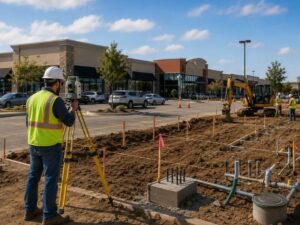
A construction surveyor faces a different job on a retail expansion. New construction starts with an empty site. A retail expansion starts with a building already there. Parking is already in use. Tenants are often still open for business during the work. For developers expanding a retail property in Hollywood, the layout has to fit around all of that. Good staking keeps the project moving. It also keeps the business next door open and happy. This guide covers what makes retail expansion different. It shows how staking works around a building that’s already there. It also covers what to check before construction starts.
Building Next to a Business That’s Still Open
New construction starts with open land. A retail expansion does not. The building is already standing. The parking lot is already full of cars. Tenants are often still working inside during construction.
This changes what a construction surveyor checks first. Distance from the existing building matters a lot. Parking counts matter too. So do the paths customers and trucks use to get in and out. Crews often can’t close these paths. Doing so would hurt the businesses still open next door.
Anchoring the New Layout to What’s Actually There
Staking an addition starts with one key step. The surveyor must confirm exactly where the existing building sits. This means real field measurements. It does not mean trusting an old site plan.
This step catches problems early. An old plan might show a building in one spot. The real building might sit a few inches off from that spot. Checking this first keeps the new addition lined up the right way.
Counting Spaces: Parking and ADA Rules During Expansion
Retail expansions often cut into parking space during construction. This is often just for a while. Local rules set a minimum number of spaces. This number ties to the building’s square footage. Some of those spaces must meet ADA rules.
A construction surveyor stakes the parking layout with this in mind. The goal is a finished count that meets code. This includes the size of each accessible space. It includes van spaces too. It includes the path from those spaces to the front door. Getting this wrong can delay your final approval. The parking layout would need fixing first.
Where the Bank Branch or Drive-Thru Actually Belongs
Shopping centers often have small extra buildings. These sit apart from the main store. A bank branch is one example. A coffee shop with a drive-thru is another. These are called pad sites. Staking one needs care. The surveyor confirms its spot next to the main building. They also check its spot next to the parking lot and shared roads.
This work also checks how cars and people move through the site. A pad site placed too close to the main entrance causes problems. It can block the view of the store. It can also slow down cars trying to reach parking. A construction surveyor checks these distances against the approved plan. This happens before any stakes go into the ground.
Digging Without Hitting What’s Already Buried
Older retail properties already have utility lines in the ground. These serve the current building. A new expansion has to avoid these lines. At the same time, it needs new lines for the added space.
A construction surveyor finds and marks these old lines first. This happens before any digging starts. Skipping this step is risky. Hitting a live utility line can shut off power or water. That would hurt the tenants still working next door during construction.
Bringing a Surveyor Into the Project: The Right Order
- Confirm the real spot of the existing building and parking lot before you finish your expansion design.
- Ask for staking on the new structure. Tie it to the confirmed spot of the existing building.
- Check that parking counts and ADA spaces are staked right before paving starts.
- Have the crew stake around any old utility lines that serve the current building.
- Keep the staking papers on file. You will need them for permits and later reference.
The Price of Skipping This Step
Skipping this step does not remove the risk. It just delays the moment someone finds the problem.
- A new addition staked without checking the real building spot can end up crooked once work starts. Fixing this mid-project costs a lot.
- A parking layout staked without checking ADA rules can fail inspection. This delays your final approval until the spaces get fixed.
- A pad site staked too close to the main entrance can cause a traffic problem. This often shows up only after that tenant opens for business.
Projects that check staking early avoid these problems. Projects that skip this step find out the hard way. By then, construction is already underway. A fix costs far more than it would have during planning.
Frequently Asked Questions
How is construction staking for a retail expansion different from staking a new building?
A retail expansion must fit around an existing building, active parking areas, and businesses that remain open during construction. The surveyor first verifies the existing structure before staking the new addition.
Does a retail expansion usually require a new parking count?
Yes. Expanding a retail building often changes parking requirements based on local regulations. This may include updating the total number of parking spaces and ADA-compliant spaces.
Can construction staking help avoid utility conflicts during a retail expansion?
Yes. Construction staking helps locate existing utilities before excavation begins, reducing the risk of disrupting power, water, or other services to operating businesses.
What is a pad site, and does it require separate construction staking?
A pad site is a separate building located within a larger retail development, such as a restaurant or bank. It typically requires its own construction staking to verify its location in relation to nearby buildings, parking areas, and roadways.
What happens if an expansion is built without verifying the existing building location?
If the existing building is not accurately verified before staking, the new addition may be misaligned. Correcting the error during construction can lead to costly delays and rework.
For a free land surveying quote, call us at (954) 516-2680 or send us a message by going here.
Posted in land surveying, land surveyor | Tagged Construction Survey, Construction Surveyor