
Can a Surveyor for Fence Replacement Prevent Neighbor Disputes?
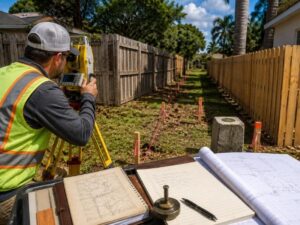
Replacing a fence sounds simple. Pull out the old posts, put in new ones. But in Hollywood, Florida, that process starts neighbor disputes every year. The old fence may not sit on the actual property line. A survey before fence work begins is what keeps a simple project from turning into a legal problem.
Why Old Fence Lines Can Be Misleading
Old fences are not proof of where a property line sits.
In Hollywood, many fences were installed decades ago without any survey. The homeowner guessed. The contractor eyeballed it. Nobody pulled records. The fence went in and stayed there for 30 years. Now it feels permanent. It isn’t.
Broward County property records don’t change because a fence has been standing in the wrong spot. The legal boundary is what the recorded plat says, not where the old wood posts happen to be.
Fences also shift over time. Tree roots push them. South Florida’s wet and dry seasons move the ground. A fence that started two feet inside the property line may sit much closer to the neighbor’s side after years of heavy rain.
What Homeowners Get Wrong About Existing Fences
Many homeowners assume that if a fence has been in place long enough, the location becomes legally valid. That’s rarely true in Florida.
Adverse possession claims require open, continuous and hostile use of another person’s land for at least seven years under Florida Statute 95.16. A fence sitting a few inches over the line for years doesn’t transfer ownership of that strip of land.
Replacing that fence in the same wrong location doesn’t fix the problem. It repeats it, and gives the neighbor fresh grounds to raise a dispute.
What Happens When a Replacement Fence Moves a Few Feet
A few feet sounds like nothing. On a tight residential lot in Hollywood, a few feet is a big deal.
Say the replacement fence goes two feet closer to the neighbor’s house than the actual property line. Those two feet may cover part of their driveway, cut off side yard access or block a utility easement. Broward County requires permits for most fence construction, and permit reviewers check that fence placement matches the legal boundary shown on the site plan.
A fence built without a survey and without a permit creates two problems at once. The county can order removal. The neighbor can file a complaint. Both outcomes cost more than the fence itself.
Encroachment claims in Florida can result in court orders requiring a fence to be torn out and rebuilt at the owner’s expense, including attorney fees if the dispute reaches litigation.
How Survey Evidence Resolves Boundary Questions
A boundary survey produces a legal document. It shows the exact location of property corners based on the recorded plat, deed descriptions and physical monuments found in the field.
When a licensed surveyor sets or locates property corners before fence installation, the contractor has clear markers to work from. No guessing. The fence goes where the law says the property ends.
In Hollywood, many older neighborhoods were platted in the 1940s and 1950s. Original survey monuments are sometimes buried under decades of asphalt or landscaping. A licensed surveyor knows how to find them or re-establish them using proportionate measurement under Florida Administrative Code Chapter 5J-17.
Survey evidence also carries weight if a dispute does arise. A neighbor claiming a fence crosses onto their land has a much harder argument when the installer worked from a certified survey document.
What the Survey Report Shows
A boundary survey for fence work typically includes:
- The exact location of all four property corners
- The position of existing structures relative to the boundary
- Recorded easements that may affect where a fence can legally go
- Any encroachments from neighboring structures already crossing the line
Preventing Encroachment Claims Before Construction Begins
An encroachment claim starts when one property owner builds something that crosses onto a neighbor’s land. Fences are among the most common sources of encroachment disputes in residential areas.
In Broward County, fence permit applications require a site plan showing fence location relative to property lines. Without a survey, that site plan is a guess. Either way, the legal liability sits with the property owner who built the fence.
A boundary survey before applying for the permit solves this at the source. The survey feeds directly into the permit application. If a neighbor later challenges the placement, the survey record is already on file.
This matters especially in Hollywood neighborhoods where lots are small and houses sit close together. A six-inch error on a 50-foot-wide lot is a much bigger problem than the same error on a half-acre property.
Replacing a Fence With Confidence Using Accurate Survey Data
Accurate survey data takes the guesswork out of fence replacement.
The licensed surveyor visits the site, locates or re-establishes the property corners and marks them clearly. The fence contractor works from those marks. The permit application includes the survey. The fence goes in on the legal boundary. The neighbor has no grounds for a dispute because the placement is documented and verifiable.
This also protects the fence owner during a future sale. If a buyer’s title company flags an encroachment, the survey record answers the question immediately.
Skipping the survey to save a few hundred dollars is the kind of decision that costs thousands later. In Hollywood’s dense residential neighborhoods, where lots were platted generations ago and old fences have been sitting in the wrong places for years, that risk is real.
Frequently Asked Questions
Do I need a survey before replacing a fence?
Many fence permit applications require a site plan showing the proposed fence location in relation to the property lines. A boundary survey is the most reliable way to confirm accurate fence placement before construction begins.
What if the old fence was in the wrong place for years?
A fence does not automatically become the legal property line simply because it has been there for a long time. Boundary ownership depends on legal property records and applicable state laws. If there is uncertainty, a boundary survey can establish the correct property line before the fence is replaced.
How does a surveyor mark property corners for fence work?
A surveyor locates existing property monuments or re-establishes missing corners using accepted surveying standards. Property corners are typically marked with durable monuments or iron pins that contractors use as reference points when installing the new fence.
Can a neighbor dispute a fence location after it’s built?
Yes. If the fence is installed in the wrong location, a neighbor may challenge its placement. Having a certified boundary survey completed before construction provides documented evidence of the property’s legal boundaries and can help prevent disputes.
What does a boundary survey for fence work include?
A boundary survey typically identifies property corners, boundary lines, existing improvements near the property line, recorded easements, and any visible encroachments that could affect fence placement.
For a free land surveying quote, call us at (954) 516-2680 or send us a message by going here.
Posted in land surveying, land surveyor | Tagged Survey for fence